Mostrando entradas con la etiqueta Schools. Mostrar todas las entradas

29 ene 2018

Succeeding with resilience – Lessons for schools - PISA evaluation

Succeeding with resilience – Lessons for schools


Many children entering school today are likely to end up working in jobs that do not yet exist. Preparing students for these unchartered territories means that we not only have to make sure that they have the right technical capabilities but that we have to strengthen their emotional and social skills. Resilience, the individual capacity to overcome adverse circumstances and use them as sources for personal development, lies at the core of being able to successfully adapt to change and thus actively engage with our digital world.

The 2017 edition of the OECD Employment Outlook shows rising levels of socio-economic inequality driven, among other factors, by automation in the labour market. Understanding how to support resilience in students is essential not only for equipping them to thrive in a digital future but also for creating more equal opportunities in education and thereby strengthening social cohesion.


Despite being from among the poorest 25% in their country, one in four disadvantaged students is academically resilient, meaning that he or she performs at Level 3 or above in all three core PISA subjects. 

• In Canada, Denmark, Estonia, Finland, Germany, Hong Kong (China), Ireland, Japan, Korea, the Netherlands, Norway, Singapore, Slovenia and Viet Nam, more than 30% of disadvantaged 15-year-old students are academically resilient. 

• Across the vast majority of education systems, schools in which students have the greatest chances of being academically resilient share some common attributes – chief among which is a good disciplinary climate, meaning that students can focus in class and teachers can provide well-paced instruction.


The bottom line 

Socio-economically disadvantaged students often encounter obstacles that prevent them from developing their full potential at school – and thus limit their ability to contribute to society and benefit from learning opportunities later on in life. 

Removing these obstacles is one of the principal goals for education systems. By ensuring that disadvantaged students learn in orderly classrooms, and enriching their learning with purposeful extracurricular activities, schools can be at the vanguard of creating more inclusive and fair societies.

Academic resilience 

22 ene 2018

How to prepare students for the complexity of a global society


How to prepare students for the complexity of a global society


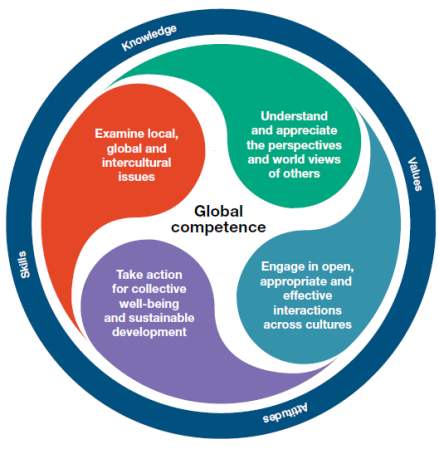
Schools can make an important difference. They are the first place where children encounter the diversity of society. They can provide students with opportunities to learn about global developments that affect the world and their own lives. They can teach students to develop a fact-based and critical worldview and equip students with an appreciation of other cultures and an awareness of their own cultural identities. They can engage students in experiences that facilitate international and intercultural relations. And they can promote the value of diversity, which in turn encourages sensitivity, respect and appreciation.


23 ene 2014

Who are the school truants?


Across OECD countries, 18% of students skipped classes at least once in the two weeks

prior to the PISA test, and 15% of students skipped a day of school or more over

the same period.

Few students in high-performing school systems skip classes or days of school.


For students in OECD countries, skipping classes is associated with a 32-point lower

score in mathematics, while skipping days of school is associated with a 52-point

lower score.

 
Truancy is observed among all students, whether advantaged or disadvantaged.


Results from PISA 2012 show that playing truant is negatively
associated with student performance. Results also show that students are less
likely to play truant when they are engaged with school. Parents and teachers
can nurture students’ engagement with and at school by holding high expectations
for their children/students and by being more engaged, themselves, in their
children’s/students’ lives.


17 nov 2012

Reducing the concentration of disadvantage in individual schools is thus a good first step towards helping immigrant students integrate successfully into school and, ultimately, society

How do immigrant students fare in disadvantaged schools? PISA in focus 22

Immigrant students often have to overcome multiple barriers at once in order to succeed at school.

• Across most OECD countries, poor performance among immigrant students relative
to other students is strongly related to social disadvantage at school, as reflected in
the proportion of students whose mothers have low levels of education.

• The concentration, in a school, of immigrant students or of those who do not speak
the language of instruction at home is not as strongly related to poor performance.


 When analysing student performance through this prism, poor student performance, particularly
among immigrant students, is most strongly related to the proportion of students in a school whose
mothers have low levels of education. This finding indicates that immigrant students – indeed all
students – face a major obstacle to success at school when they are concentrated in schools
attended by students who face similar socio-economic disadvantage.

 
La concentración de estudiantes inmigrantes en un mismo centro es un factor casi neutral en España en relación al rendimiento escolar.


Student performance is not necessarily hindered by the concentration of immigrants in a school or class. But the concentration of socio-economic disadvantage in a school is strongly associated with poor
student performance. Reducing the concentration of disadvantage in individual schools is thus a good first step towards helping immigrant students integrate successfully into school and, ultimately, society.


6 sept 2011

Books and bits: What Will School Look Like in 10 Years?


In Classroom of Future, Stagnant Scores.


The future of technology in the classroom, visit the Bits blog
Mr. Cuban believes that change in education will not come as quickly as many predict. He noted that some reformers have been attempting to end summer vacation for decades. “Summer is still here,” he said.


The classrooms that used the laptops the most often were not necessarily the most successful.As schools rely more on laptops and mobile devices, it is crucial to determine when students benefit from the presence of the computers and when teachers should put them away, he said.

Strategic recommendations:
Focus on learning with technology, not about technology.
Emphasize content and pedagogy, and not just hardware.
Give special attention to professional development.
Engage in realistic budgeting.
Ensure equitable, universal access.
Initiate a major program of experimental research.